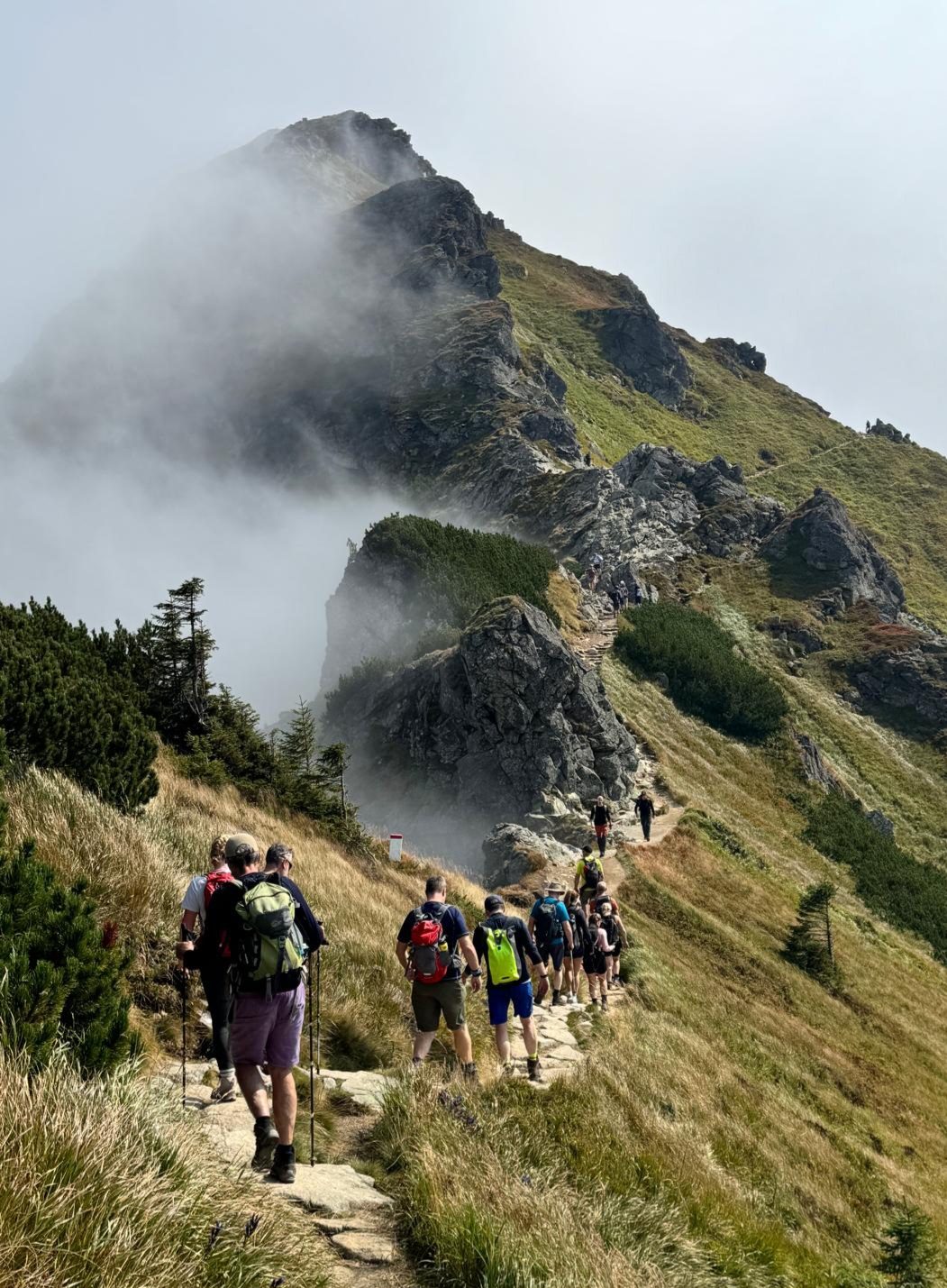
The Yorkshire Three Peaks is a walk of about 24 miles (39 km) over Pen-y-ghent, Whernside and Ingleborough, starting and finishing in Horton-in-Ribblesdale. The target is to finish within 12 hours. A fit, trained group usually takes 11 to 12 hours, and the three climbs add up to over 1,700 metres of ascent.
The Yorkshire Three Peaks is one of the most popular walking challenges in Britain, and for good reason. It links the three great hills of the Yorkshire Dales, Pen-y-ghent (694 m), Whernside (736 m) and Ingleborough (723 m), into one long circuit from the village of Horton-in-Ribblesdale.
We have been leading groups round it since 2008: at least 26 events and more than 350 walkers booked, from small groups of friends to a corporate team of 47. This guide is built from that experience: our route cards, our checkpoint logs and what our Mountain Leaders have learned about where the day goes right and wrong.
The route
The circuit starts and finishes in Horton-in-Ribblesdale. Here is our standard clockwise route, with the distance walked by each point.
| Point | Distance so far | Notes |
|---|---|---|
| Horton-in-Ribblesdale | 0 km | Start, car park in the village |
| Ingleborough summit | 7.6 km | First climb, steep final section |
| Philpin Farm | 11.9 km | Food stop, packed lunches can be pre-ordered |
| Whernside summit | 16.0 km | Highest point of the day |
| The Station Inn, Ribblehead | 22.6 km | Toilets and refreshments |
| Pen-y-ghent summit | 34.5 km | Last climb, rocky step near the top |
| Horton-in-Ribblesdale | About 39 km | Finish |
Height along the route
The route is not signposted all the way round. There are short road sections at Chapel-le-Dale and near Ribblehead, including about a mile on the B6479, which can be busy with motorbikes at weekends.
Clockwise or anticlockwise?
The traditional way round is anticlockwise, climbing Pen-y-ghent first. With groups we usually go the other way, and our leaders' notes from 2012 still explain why:
- You reach the first checkpoint after about seven miles instead of nine.
- You cross the boggiest section, between Ribblehead and Pen-y-ghent, later in the day when the ground has had time to drain.
- You take the steepest faces, the north edge of Ingleborough and the south edge of Pen-y-ghent, downhill on fresh legs rather than uphill on tired ones.
- It is quieter, so there is less queuing at the narrow sections.
The anticlockwise route works well too, and we use it when a group is based in Ingleton, because the walk then finishes at the door.
How long does it take?
The traditional target is 12 hours. A fit, trained group walking together will usually finish in 11 to 12 hours, including short stops. This is how our timing card breaks it down for an anticlockwise group.
| Leg | Distance | 11 hour pace | 12 hour pace |
|---|---|---|---|
| Start to Pen-y-ghent | 3.7 km | 1 h 21 | 1 h 29 |
| Pen-y-ghent to feed station | 3.9 km | 1 h 10 | 1 h 17 |
| Feed station to Ribblehead | 7.6 km | 1 h 48 | 1 h 57 |
| Ribblehead to Whernside | 6.6 km | 1 h 57 | 2 h 07 |
| Whernside to Philpin Farm | 3.9 km | 1 h 10 | 1 h 18 |
| Philpin Farm to Ingleborough | 4.4 km | 1 h 29 | 1 h 37 |
| Ingleborough to finish | 7.9 km | 2 h 02 | 2 h 14 |
What it looks like on the day
On a corporate event of 47 walkers in July 2025, walking anticlockwise from a 7am start, the group was off Pen-y-ghent by 8.15am and on Whernside by 12.40pm. The fastest group of 17 finished just after 5.15pm, a second group of 11 came in just after 6pm, and the last walker finished at 6.49pm. Three people stopped early and were taken back to base.
On a hot day in June 2026, three of a group of fifteen decided to stop at Ribblehead and took the train back. The other twelve completed all three peaks. Heat catches more people out than rain does.
How hard is it?
It is a long, demanding day rather than a technical climb. Almost everyone who does the training finishes, and the people who struggle usually do so for the same few reasons.
- The rocky step on Pen-y-ghent. A short section of about 20 metres near the top where you may need to use your hands. It is the part of the route we watch most closely, especially when it is wet or people are tired.
- Ingleborough's steep sides. A steep climb and descent, and the easiest place for a group to spread out. Our leaders regroup before the summit plateau.
- The bog. The stretch between Pen-y-ghent and Ribblehead is famously wet, and can be treacherous after rain. Wear boots, not trainers, and gaiters help.
- Limestone. The limestone pavement is very slippery when wet and full of deep cracks, and there are sink holes near the path. Stay on the path, particularly in poor visibility.
- Stopping too often. The biggest threat to finishing is not a single hill. It is the time lost when people stop individually and often. We walk together for 40 to 50 minutes, then all stop together for a few minutes.
How to train
We give every walker an 8 or 12 week training plan. The aim is simple: by the end, you should be able to walk six hours or more on hilly ground and feel fine the next day.
- Build up to several long walks on similar ground, ideally with climbs, rather than only flat miles.
- Walk in the boots and with the pack you will use on the day.
- Add some leg strength work, such as squats, lunges and step-ups.
- Practise eating and drinking on the move. On a long day, little and often beats a big lunch.
If you have not been able to put the training in, it is worth being honest with yourself before the day. It is a far better experience when you are ready for it.
If the Yorkshire Three Peaks goes well, the National Three Peaks is the natural next step.
What to take
Most people start in a t-shirt and waterproof and add layers as they climb.
When to do it
The main season runs from April to September, and we have led the challenge in April, May, June, July and September. Longer daylight in May, June and July gives the most margin. In late July you can expect around 18°C during the day, and it can be warm and wet at the same time. Early starts are normal: we are usually walking by 7am.
Getting there and where to stay
Horton-in-Ribblesdale and Ribblehead are both on the Settle to Carlisle railway, which makes the challenge easy to reach by train and gives walkers a way home from Ribblehead if they need to stop. Groups tend to stay in Horton itself, in Ingleton, or in Skipton with a minibus transfer in the morning.
Food and toilets along the way are limited. There are toilets in Horton, at the Station Inn at Ribblehead and at Philpin Farm, where a snack bar opens in the season.
How we keep groups safe
- Every group is led by qualified Mountain Leaders, at a ratio of one leader to every twelve walkers, with at least two leaders on every event and an extra leader to walk anyone off early.
- Walkers wear numbered armbands and sign in at checkpoints.
- We plan exit points at Clapham Lane, Philpin Farm, Ribblehead and on the Pennine Way above Horton, so anyone can stop safely and get back to base.
- We follow the Met Office warnings: a yellow warning means we continue with care, amber means we shorten or re-route, red means we cancel. In high heat we add electrolytes and shuttles, and finish early if we need to.
Common questions
How long does the Yorkshire Three Peaks take?
Most trained groups finish in 11 to 12 hours, including short stops. The traditional target is 12 hours. On our July 2025 event of 47 walkers, the first group finished in just over 10 hours and the last walker came in just under 12.
How far is the Yorkshire Three Peaks?
About 24 miles, or 39 km, with over 1,700 metres of climbing in total.
Which way round should you walk it?
Either works. The traditional way is anticlockwise, Pen-y-ghent first. With groups we often go clockwise, Ingleborough first, because you reach the first checkpoint sooner, hit the boggiest section later in the day, and take the two steepest faces downhill.
Is the Yorkshire Three Peaks hard?
It is a long, demanding day rather than a technical one. The walking is on paths, but there is a short rocky step on Pen-y-ghent where you may need your hands, steep ground on Ingleborough, and a very boggy stretch between Pen-y-ghent and Ribblehead. Endurance is what decides whether people finish.
How much training do you need?
We give walkers an 8 or 12 week plan. If you can comfortably walk six hours or more on hilly ground by the end of it, you should be able to complete the challenge.
Can you get the train to the Yorkshire Three Peaks?
Yes. Horton-in-Ribblesdale and Ribblehead are both stations on the Settle to Carlisle line, and Ribblehead is a useful way home for anyone who needs to stop partway.
Walk the Yorkshire Three Peaks with us
We run it for corporate teams, charities and private groups, with Mountain Leaders at one to every twelve walkers, checkpoints, food stops and transport sorted. You just do the walking.