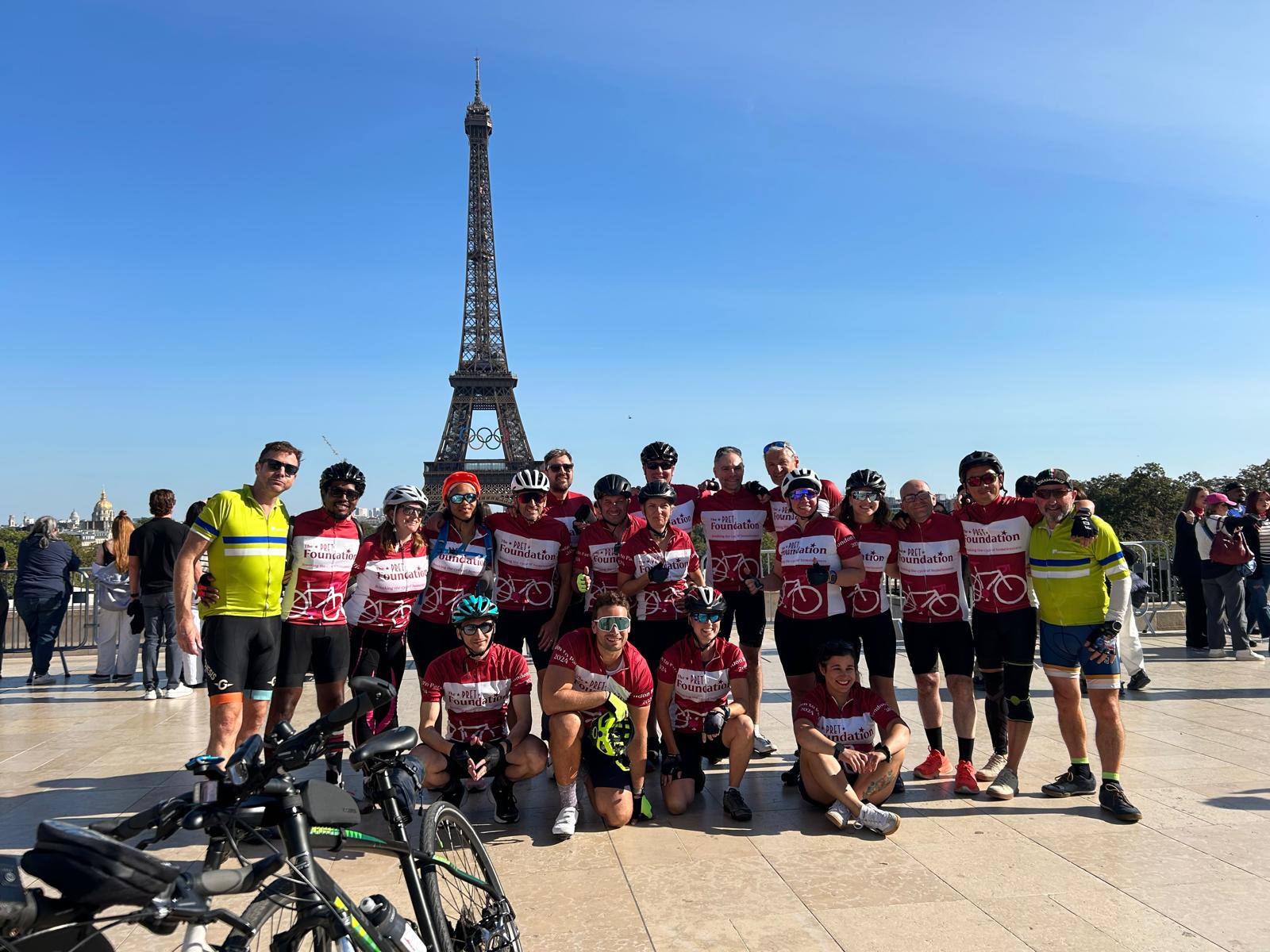
The London to Paris bike ride covers about 300 km (roughly 190 miles), usually over three riding days via the Newhaven to Dieppe ferry. Day one is the hardest, about 100 km with over 1,000 metres of climbing to catch the evening ferry. Days two and three are flatter, much of day two is on a traffic-free greenway, and you finish at the Eiffel Tower on the afternoon of day three. There is also a 24 hour version for experienced riders.
London to Paris is the classic British charity bike ride: out of the capital, over the hills of Surrey and Sussex, across the Channel and into France on quiet roads and greenways, finishing in front of the Eiffel Tower. It is a real challenge, but it is well within reach of anyone who trains for it.
We have run it for corporate teams, charities and private groups since 2008. More than 1,300 riders have booked a London to Paris ride with us, across more than 80 departures over three days, four days and 24 hours. Our biggest group was 68 riders. This guide is based on our current route and our ride leaders' logs.
The route, day by day
Our three day ride crosses the Channel on the evening ferry from Newhaven to Dieppe.
| Day | Route | Distance | Climbing |
|---|---|---|---|
| 1 | London to Newhaven, evening ferry to Dieppe | about 103 km | about 1,080 m |
| 2 | Dieppe to Beauvais, mostly on the Avenue Verte greenway | about 120 km | about 670 m |
| 3 | Beauvais to Paris via Pontoise, finishing at the Trocadéro | about 89 km | about 710 m |
Day 1
Day 2
Day 3
All three days drawn to the same scale from our 2026 route files. Day one is the hilly one.
Day 1 heads south out of London via Warlingham, East Grinstead and Chailey to the port at Newhaven, and it is the hilliest day of the ride. You then board the evening ferry, arriving in Dieppe late at night for a short ride to the hotel.
Day 2 is the day most riders enjoy most. Much of it runs along the Avenue Verte, a traffic-free greenway through the Normandy countryside, via Neufchâtel-en-Bray and Forges-les-Eaux to Beauvais.
Day 3 crosses the rolling farmland of the Vexin to Pontoise, then into Paris, around the Arc de Triomphe and on to the Trocadéro for the photo in front of the Eiffel Tower.
How a day runs
We roll at 8am each day, with a feed stop every couple of hours and a proper lunch stop. On day one, lunch is usually in East Grinstead and the last stop is a village pub in Sussex before the final push to Newhaven for mid-afternoon.
Day one has a deadline the other days do not: the ferry will not wait. You need to be at the port an hour and a half before sailing, which means averaging about 16 km/h while moving. Our leaders track time all day and trim stops if the group falls behind:
- 10 to 20 minutes behind, the next stop is shortened.
- 20 to 30 minutes behind, lunch is shortened or a stop is skipped.
- More than 30 minutes behind, we only make the essential stops.
It is why you will hear the phrase "we are rolling in two minutes" a lot on day one.
The 24 hour version
The 24 hour ride is for experienced riders. We have run at least 18 of them since 2012, with more than 250 riders. It covers about 280 km without a night in a hotel. You leave Westminster at 2pm, ride about 105 km to Newhaven, board the late ferry and try to sleep, then roll out of Dieppe at around 5.30am for about 176 km to Paris, reaching the Eiffel Tower at around 2.30pm.
The pace in France needs to sit at about 25 km/h whenever the roads allow, and the stops are short. There are no cabins on the overnight crossing, so bring a travel pillow, an eye mask and a warm layer, and keep your passport in a small grab bag you can carry on board.
Where it goes wrong
Most of what goes wrong on London to Paris is avoidable, and our leaders' logs show the same things coming up.
- The group splitting. Riders in the middle lose sight of the leader and miss a turn. Keep the rider in front in sight, and regroup at the top of climbs.
- Mechanical problems. Worn cleats are the most common spare part we hand out, followed by punctures. Bikes without quick-release wheels slow down a roadside repair, so check your bike before the ride.
- Pace. A rider who is well below the group's speed on day one puts everyone's ferry at risk. If you are struggling, our support van can move you forward to the next stop, which is no shame and keeps the group on time.
- Arriving in Dieppe in the dark. You need working front and rear lights and warm clothing for the short ride from the ferry to the hotel.
How to train
Aim to be able to ride 100 km with a good amount of climbing comfortably, and then ride again the next day. Most riders need three to four months.
- Build your longest ride steadily, adding 10 to 15 km at a time.
- Include hills, because day one is hilly and the climbs are what tire people out.
- Do at least two weekends of back-to-back long rides before the event.
- Ride the bike you will use on the day, in the kit you will wear, and practise eating and drinking on the bike.
- Get used to riding in a group, keeping a steady line and calling out hazards.
Your bike
A good road bike is ideal, and a well-maintained hybrid works if you have trained on it. We recommend 25 to 28 mm puncture-resistant tyres. Tubular tyres are not suitable. If you do not have a suitable bike, you can hire a road bike from us.
Have your bike serviced a couple of weeks before the ride, not the day before, so there is time to fix anything the mechanic finds.
What to take
Our support van carries a day bag of up to 30 litres and your overnight bag of up to 20 kg, so you only carry what you need on the bike.
When to ride
We run London to Paris from May to September. In May expect around 14°C during the day and cooler early mornings, so pack arm and leg warmers. Midsummer is warmer and gives the longest days.
How we keep groups safe
- A ride leader sets the pace at the front, with extra leaders on larger groups and a support driver and van following the group.
- Our leaders hold 16 hour outdoor first aid qualifications.
- We brief every group on our safe cycling rules: ride single file unless the road is clear, no headphones, keep braking distance, regroup at the top of climbs and never overtake on a descent.
- We follow the weather: in sustained winds over 30 mph or gusts over 40 mph we consider a different route, and an amber warning means we shorten, re-route or delay.
Common questions
How long does it take to cycle from London to Paris?
Most people ride it over three days, covering about 100 km, 120 km and 90 km. Riders who want a bigger challenge do it in 24 hours, setting off from Westminster in the afternoon, crossing on the overnight ferry and reaching the Eiffel Tower the next afternoon.
How far is London to Paris by bike?
About 300 km, or roughly 190 miles, on our three day route via Newhaven and Dieppe. The 24 hour version is a little shorter, at about 280 km.
What is the hardest part of London to Paris?
Day one. It is the hilliest day, with over 1,000 metres of climbing through Surrey and Sussex, and you have to reach Newhaven in time for the ferry. Days two and three in France are flatter.
Do I need a road bike?
A good road bike is best, but a well-maintained hybrid is fine if you train on it. You can also hire a road bike from us. Tubular tyres are not suitable, and we recommend 25 to 28 mm puncture-resistant tyres.
How do you get home from Paris?
Riders come home on the Eurostar and we bring the bikes back to London in our support van.
How much training do I need for London to Paris?
Enough to ride 100 km with plenty of climbing comfortably, and then do it again the next day. Most riders train for three to four months, building up to back-to-back long rides.
Ride London to Paris with us
We run it for corporate teams, charities and private groups, with ride leaders, a support van for your bags and any tired legs, hotels, the ferry and the Eurostar home all sorted.